
Former Phuket governor supports metropolis plan but warns of security and administration risks
Former Phuket governor Nirat has backed decentralisation but warned that abolishing existing provincial administration under the proposed Phuket Metropolis Act could create risks for national security, emergency coordination, public services and provincial revenue collection.
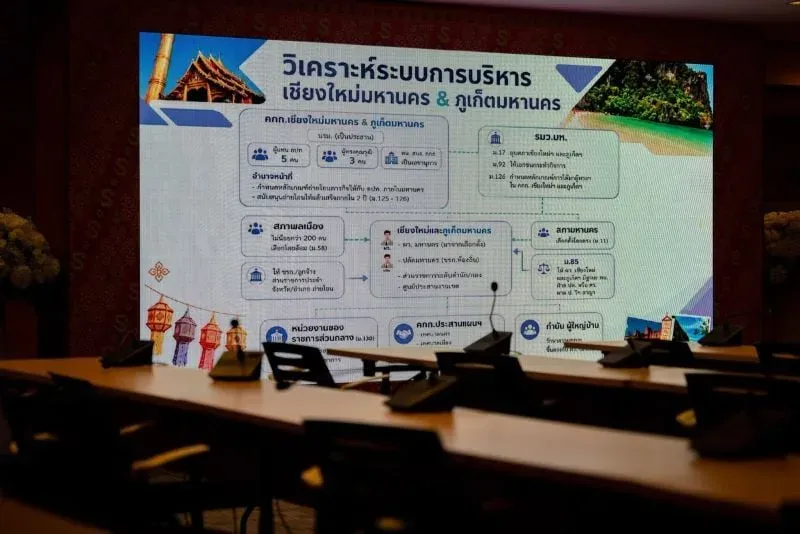
Former Phuket governor Nirat has backed decentralisation while warning that a proposal to establish Phuket as a special metropolitan administrative organisation requires careful consideration before existing provincial administration is abolished.
Mr Nirat, now Deputy Permanent Secretary of the Ministry of Interior, chaired a high-level meeting on Wednesday, July 15, to review draft legislation covering both Phuket and Chiang Mai. The meeting examined the structural effects of the proposed laws before the ministry submits its recommendations to the Cabinet.
Opening the meeting, Mr Nirat said the ministry “fully supports decentralisation” to local administrative organisations. He cautioned, however, that restructuring metropolitan administration would require consideration “in every dimension” because it could remove regional administration from the area.
The concerns include maintaining national security, preserving an effective single-command structure during emergencies and preventing inequalities in provincial revenue collection. Mr Nirat described provincial administration as the “central link” between national policy and local implementation, warning that removing it could affect public services and public safety.
The ministry will compile recommendations from the meeting before forwarding its assessment to the Office of the Prime Minister and the Cabinet. The review treats Phuket and Chiang Mai as a single proposal, although supporters of the Phuket Metropolis Act have argued that the two provinces face different circumstances.
Supporters say Phuket’s economy is unlike that of other provinces and requires a different governance model. The province received 4.9 million visitors during the first four months of this year, generating 186.9 billion baht in tourism revenue. It has a resident population of about 420,000 people.
Advocates argue that Phuket does not receive funding proportional to the revenue it generates and needs greater control over its budget and administration. They say a special local authority could help address long-standing problems including traffic congestion, infrastructure, wastewater management and rapid urban growth.
The proposed law would replace the centrally appointed provincial administration with a special local authority, similar in principle to Bangkok’s system, and give Phuket greater autonomy over its affairs.
Mr Nirat’s comments mark a shift in emphasis from his time as Phuket governor, when he was regarded as supportive of greater decentralisation for the island. His transfer to Bangkok took effect on June 25 following a Royal Gazette announcement, ending a tenure of just over eight months as governor.
The transfer was part of a major reshuffle of Phuket’s provincial administration after Prime Minister Anutin Charnvirakul intervened over complaints involving allegations of corruption, the influence of local power brokers and conflict among senior provincial officials.
The latest review follows earlier delays to the legislation. House Speaker Wan Muhammad Noor Matha rejected an earlier draft of the Phuket Metropolis Act last year on constitutional grounds. Phuket MPs and supporters have since revised the proposal and continue to seek parliamentary approval.