
Phuket governor revisits traffic plans as congestion strains roads
A Phuket traffic meeting restated timelines for major road and transit projects and revisited measures including Park & Ride facilities and AI-controlled traffic lights.
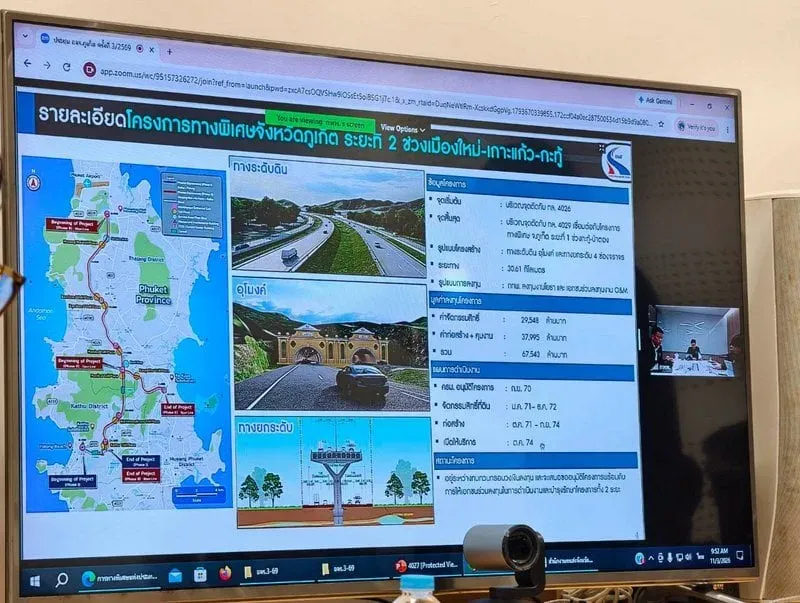
Phuket Governor Chotinarin Kerdsom chaired a traffic meeting on 3 November that restated plans for major road and transit projects while revisiting congestion measures previously included in government announcements.
The third meeting of the 2026 Phuket Road Traffic Management Subcommittee was held at Provincial Hall and attended by Vice Governor Romdon Hayiawae and representatives of relevant agencies. Officials reviewed infrastructure projects, congestion and preparations for the high season.
Projects remain years away
The first phase of the Kathu-Patong Expressway, also known as the Patong Tunnel project, covers about four kilometres and remains in the process of being submitted to the Cabinet. Construction is expected to begin in 2027, with the road scheduled to open in 2031.
The second phase, the approximately 30km Mueang Mai-Ko Kaew-Kathu Expressway, has received approval for its Environmental Impact Assessment report. It is expected to be submitted to the Cabinet in 2027, with construction scheduled to start in 2028 and operations in 2031.
The Phuket Mass Transit System, a light rail project linking Phuket International Airport with Chalong Circle, remains in administrative procedures. The Ministry of Transport has directed that construction should begin only after the expansion of Route 4027 through Pa Khlok is completed, to minimise disruption. Construction is now expected to start in late 2029, with operations scheduled for December 2032.
The Route 4027 expansion between Baan Para and Baan Mueang Mai still faces land handovers, permission to use forest land and the relocation of utility poles. Governor Chotinarin urged the agencies involved to coordinate on resolving the obstacles and keeping the project on schedule.
Officials also presented a study on upgrading Thepkrasattri Road, or Route 402, including proposed changes to road medians, U-turn points and bottlenecks, as well as additional road-safety equipment.
High-season measures revisited
The meeting was told that Phuket has more vehicles and congestion on major roads, at intersections and in tourist areas, particularly during the high season. Officials cited limits in the existing road network, roadside parking and the need for a more integrated public transport system.
Proposals included Park & Ride facilities, expanded electric-vehicle shuttle bus services and an artificial-intelligence traffic-control system able to analyse traffic volumes and adjust traffic lights in real time. Officials also discussed regulating the operating hours of heavy trucks and organising parking in congested areas.
An official account of the meeting provided no firm implementation dates for those measures and no confirmation that the proposed traffic-control technology is operating in Phuket. The measures had also featured in previous government plans and announcements.
Officials reported that six Category 1 bus routes and 13 Category 4 routes now cover approximately 96% of the island. The meeting also discussed existing electric-vehicle bus services, development of the four-language Phuket Bus application, parking facilities and shuttle services connecting with the city centre.
Eight directives
Governor Chotinarin directed agencies to prioritise an artificial-intelligence system for managing traffic-light timings and stronger enforcement of traffic laws, particularly against driving against traffic and illegal parking that obstructs roads.
The directives also covered designated operating hours and routes for trucks with 10 wheels or more; possible dedicated parking zones for electric vehicles; integrating cameras operated by different agencies into the Phuket Eye network; and pursuing the installation of a further 1,400 cameras.
Other priorities were improving road medians and safety equipment, including bilingual traffic signs; preventing theft of public infrastructure and electrical wiring; and strictly regulating street vendors and people operating on footpaths.
The Phuket Provincial Office was additionally instructed to consolidate project information, create a progress-monitoring dashboard, identify the agency responsible for each task and submit performance reports twice a month.