Best Temples in Phuket in 2026: Top 5, One-Day Itinerary and Dress Code
Discover the 5 best temples in Phuket, including Wat Chalong and Big Buddha, plus a practical one-day route, dress code and worthwhile temples near each main tourist area.
Phuket has dozens of Buddhist temples, but most visitors do not need to turn their holiday into a checklist of wats. If you only have time for one conventional temple, Wat Chalong is the clear first choice. Beyond that, choose the sites that match your route and interests rather than criss-crossing the island to collect more stops.
Quick answer: the five strongest choices for a first trip are Wat Chalong, Phuket Big Buddha, Wat Phra Thong, Wat Doi Thepnimit and Wat Mongkol Nimit. Together they cover Phuket's most famous temple, its iconic Buddhist landmark, an unusual half-buried Buddha, a hilltop wat with a view and an easy cultural stop in Phuket Old Town. Big Buddha is not a conventional wat, but it belongs in the Top 5 because of its religious importance and its place in almost every first-time Phuket sightseeing plan.
- The 5 best temples in Phuket
- One-day Phuket temple itinerary
- Best temples in Phuket by area
- Wat Phra Nang Sang in 2026
- Temple dress code and etiquette
- Frequently asked questions
The 5 Best Temples in Phuket
| Temple | Best for |
|---|---|
| Wat Chalong | Best overall and the one conventional temple to prioritise |
| Phuket Big Buddha | Phuket's iconic Buddhist landmark and panoramic views |
| Wat Phra Thong | Most unusual temple and the half-buried Buddha |
| Wat Doi Thepnimit | Best temple for views and a quieter Patong-area visit |
| Wat Mongkol Nimit | Best temple to combine with Phuket Old Town |
1. Wat Chalong — Best Overall
Wat Chalong earns the top spot for its religious importance, scale and variety. One of Phuket's most important Buddhist complexes, it is closely associated with the revered monks Luang Pho Cham and Luang Pho Chuang and offers enough to justify a dedicated visit.
The grounds contain several ornate buildings, Buddha images and the Grand Pagoda, which is associated with a Buddha relic. The interiors are richly decorated, and the upper levels give you a better sense of the scale of the complex. Wat Chalong remains an active religious site: local visitors come to make merit, pray and pay respect to the monks connected with the temple's history.
You will probably hear sudden explosions while walking around. Firecrackers are set off in a dedicated structure to express gratitude and make merit. The noise can be startling if you are not expecting it, especially for young children or anyone sensitive to loud sounds.
- Area: Chalong
- Entrance: free; donations are welcome
- Hours: plan around 8:00 AM–5:00 PM; some sources list an earlier 7:00 AM opening
- Time needed: about 1–1.5 hours; allow longer if you want a slow visit
- Parking: free parking is available
- Google Maps: Wat Chalong
Good to know: Wat Chalong can become busy with tour groups later in the day. An early visit is cooler and quieter, and parking is usually easier. Cover your shoulders and knees, and remove your shoes before entering buildings where required.
After your visit: Phuket Big Buddha is the obvious next stop. It is about 8 km away, typically around 20–30 minutes by car or motorbike. The two sites form the most useful temple-and-landmark pairing in south-central Phuket.
2. Phuket Big Buddha — Phuket's Iconic Buddhist Landmark
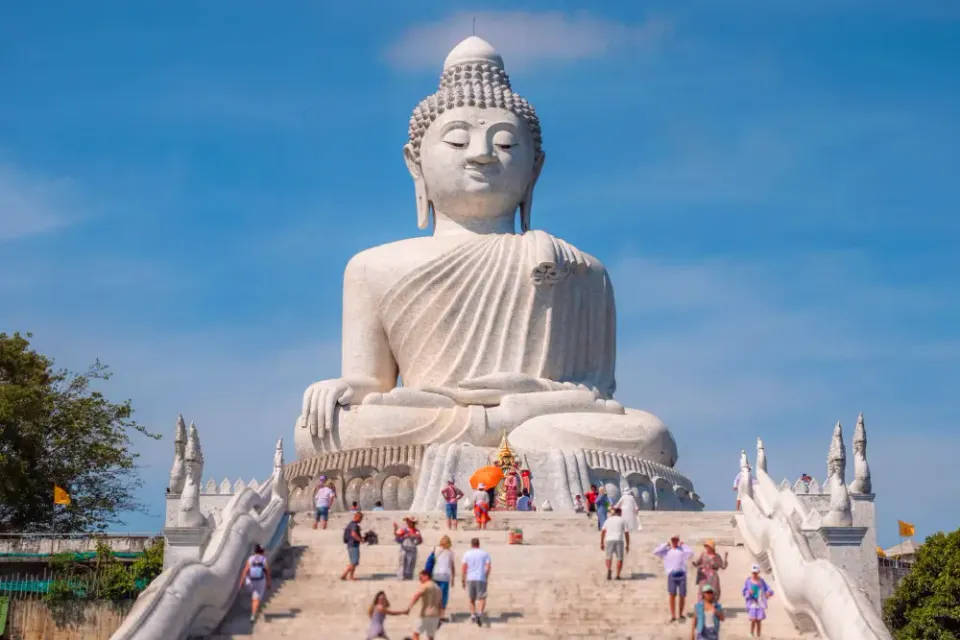
Phuket Big Buddha is one of the island's defining landmarks: a 45-metre white-marble Buddha on Nakkerd Hill, visible from large parts of southern Phuket.
The statue's scale is only part of the appeal. Panoramic terraces overlook southern Phuket, and on a clear day the views are extensive enough to place Big Buddha among the island's best viewpoints.
The site reopened on 3 March 2026 after the closure that followed the 2024 landslide. It is now managed by Wat Kittisangharam, also known as Wat Kata. Current reopening hours are 9:00 AM–6:00 PM, with last entry around 5:30 PM. The reopening remains subject to conditions set by the Royal Forest Department, and work has continued around the site, so check current access before making a special cross-island trip.
- Area: Nakkerd Hill, above the Karon/Chalong side of Phuket
- Entrance: free
- Parking: currently reported as free
- Current visitor hours: 9:00 AM–6:00 PM; last entry around 5:30 PM
- Time needed: about 45–60 minutes
- Google Maps: Phuket Big Buddha
Good to know: shoulders and knees should be covered. The road climbs steeply in places, and access conditions can change after heavy rain or site works. Older listings can still show outdated closure information, so check the current status before a dedicated trip.
After your visit: continue to Wat Chalong if you have not already been. The two are about 8 km apart and work far better as a pair than as separate cross-island outings.
3. Wat Phra Thong — Most Unusual Temple
Wat Phra Thong, also known as Wat Phra Phut, is worth the trip for the feature that immediately sets it apart: a gold-covered Buddha image that appears to rise only halfway out of the ground. The half-buried Buddha is tied to one of Phuket's best-known religious legends and gives the temple a distinct identity beyond ornate architecture alone.
The complex is in Thalang in northern Phuket and has a quieter, more local feel than Wat Chalong. It is particularly worthwhile for travellers staying around Bang Tao, Laguna, Nai Yang or the airport, and for anyone interested in Phuket's local history and religious traditions.
A small museum on the temple grounds adds another reason to stop. The provincial listing gives free entry and hours of 7:00 AM–5:00 PM for the museum, but those hours should not be treated as the opening schedule for every part of the temple complex.
- Area: Thep Krasatti, Thalang
- Entrance: free
- Museum: listed as free by the provincial authority
- Time needed: about 30–45 minutes
- Google Maps: Wat Phra Thong
Good to know: this is a better choice for history and atmosphere than for a huge architectural spectacle. If you are staying in Patong, Kata or Rawai, the journey north is long enough that it makes sense to combine the temple with another Thalang stop rather than visit it alone.
After your visit: Wat Kanan is only about 2 km away, roughly 5–10 minutes by car or motorbike. Its white ordination hall over water looks completely different from Wat Phra Thong, so the two make an excellent northern temple pair.
4. Wat Doi Thepnimit — Best Temple for Views
Wat Doi Thepnimit is the strongest temple choice for visitors staying in Patong who want something quieter than Phuket's major sightseeing stops. The small hilltop monastic site has an ornate white chedi and a wide view over Patong and the Andaman Sea.
Compared with Wat Chalong, the site feels much quieter and more compact. Its appeal comes from the combination of religious architecture, elevation and calm, especially in the late afternoon when the light improves and the heat begins to ease.
- Area: Patong Hill / Kathu
- Entrance: free
- Time needed: about 20–30 minutes
- Access: paved road, but the final approach is steep and can feel tricky
- Parking: available near the top
- Google Maps: Wat Doi Thepnimit
Good to know: the pagoda area is not always open, and the steep hill deserves extra caution in heavy rain. If you are using a taxi or ride-hailing app, it can be practical to arrange your return rather than assume a driver will immediately be available at the top.
After your visit: Patong Beach is about 4 km away, so it is easy to return to the coast rather than adding another hilltop viewpoint after a short temple visit.
Do not confuse it with Wat Thepnimit: Wat Thepnimit is a different temple in Wichit. The word Doi matters when searching the map.
5. Wat Mongkol Nimit — Best Temple in Phuket Old Town
Wat Mongkol Nimit, also known as Wat Klang, is the best major temple to weave into a Phuket Old Town day. It is an active royal and community temple with colourful roofs, a golden chedi and a much more local rhythm than Phuket's large coach-tour attractions.
Its greatest strength is location. You can visit the temple and then walk into the historic streets around Thalang Road and Soi Romanee without adding another drive. That makes it especially useful for travellers who want one cultural stop without building a full temple tour.
- Area: Phuket Old Town / Talat Yai
- Entrance: free
- Time needed: about 30–45 minutes
- Old Town: within a few hundred metres
- Sunday Walking Street: roughly 0.2–0.5 km depending on the point you use
- Google Maps: Wat Mongkol Nimit
Good to know: Wat Mongkol Nimit is best treated as part of an Old Town day rather than as a stand-alone cross-island excursion. Its value comes from combining an attractive active wat with the historic centre in the same outing.
After your visit: walk through Old Town, or continue later to Wat Khao Rang and Khao Rang Viewpoint. On Sunday, the temple also pairs naturally with the Old Town walking-street market; our Phuket night market guide covers the best evening options around the island.
One-Day Phuket Temple Itinerary
A good temple day avoids criss-crossing Phuket. This full-day route focuses on south and central Phuket, covers four of the Top 5 plus Wat Khao Rang, and finishes above Patong. Wat Phra Thong stays out because its northern location would add unnecessary backtracking.
| Stop | Plan |
|---|---|
| 1. Wat Chalong | Start around 8:00 AM. Allow about 1–1.5 hours before the larger tour groups and midday heat build up. |
| 2. Phuket Big Buddha | About 8 km from Wat Chalong, roughly 20–30 minutes. This timing brings you up the hill after the 9:00 AM opening. |
| 3. Wat Mongkol Nimit | About 16 km from Big Buddha, roughly 35–55 minutes depending on traffic and road conditions. |
| 4. Phuket Old Town | Have lunch and walk the historic centre. You are already there, so there is no reason to rush straight back into a vehicle. |
| 5. Wat Khao Rang Samakkhitham | About 2 km from Wat Mongkol Nimit, roughly 5–10 minutes by road. Add Khao Rang Viewpoint if you still want another panorama. |
| 6. Wat Doi Thepnimit | About 10 km from Khao Rang, roughly 20–30 minutes. Finish in the late afternoon for softer light over Patong. |
This is a full sightseeing day rather than a relaxed temple crawl. If you prefer more time in Old Town, stop after Wat Khao Rang and keep the rest of the afternoon for cafés, museums or the evening market. You can also adapt this route inside a longer Phuket itinerary instead of dedicating a complete day to temples.
Northern Phuket alternative: if you are staying around Bang Tao, Laguna, Nai Yang or the airport, a better half-day is Wat Phra Thong + Wat Kanan. They are only about 2 km apart, around 5–10 minutes by car or motorbike, and they look very different from each other.
Best Temples in Phuket by Area
You do not need to drive to the opposite end of Phuket every time you want to visit a temple. Outside the Top 5, many smaller wats are most valuable because they fit naturally into a beach, market or neighbourhood day.
Phuket Town and Old Town
Wat Mongkol Nimit remains the first choice in Old Town: its architecture and active religious life are easy to combine with the historic streets on foot.
Wat Khao Rang Samakkhitham is a strong second stop, and entry is free. The hillside temple has a large golden Buddha and a calmer local atmosphere, while Khao Rang Viewpoint is only about 0.9 km away. Google Maps: Wat Khao Rang Samakkhitham.
Patong and Kathu
Wat Doi Thepnimit is the best temple near Patong if you want a destination in its own right. The hilltop setting and sea view make it more distinctive than a standard neighbourhood wat.
Suwankeereewong Temple (Patong Temple) is the simpler local alternative, with free entry. It is quieter, easy to combine with a normal Patong day and about 2 km from Patong Beach. Choose it when you want a short cultural stop rather than a special excursion. Google Maps: Suwankeereewong Temple.
Kata and Karon
Wat Suwannakiri Khet (Karon Temple) is the easiest temple to visit if you are staying in Karon, and entry is free. The local night market operates right beside the temple on market days, so it can become part of an evening rather than a separate sightseeing trip. Google Maps: Karon Temple.
Wat Kitti Sangkharam (Wat Kata) is the quieter local option for Kata. Entry is free, and its green grounds and relative lack of tour groups make it useful if you want to see an active neighbourhood temple without travelling to Chalong. Any blessing or donation you choose to make should be treated separately from admission. Google Maps: Wat Kitti Sangkharam.
Thalang, Bang Tao and North Phuket
Wat Phra Thong is the northern temple worth making time for even if it is not directly beside your hotel. Its half-buried Buddha makes the journey worthwhile in its own right.
Wat Kanan is the best companion stop. Entry is free, and its white ordination hall sits over water, creating a striking visual contrast with older Phuket temples. It is only about 5–10 minutes from Wat Phra Thong. Google Maps: Wat Kanan.
Wat Choeng Thale is a practical local choice for Bang Tao and Cherngtalay visitors, and entry is free. It is not a reason to drive across Phuket, but it works well if you are already in the area, with Bang Tao Night Market about 2 km away. Google Maps: Wat Choeng Thale.
Nai Yang and Phuket Airport
Wat Mongkol Wararam (Wat Nai Yang) is a useful small cultural stop for travellers staying close to Nai Yang or the airport. Entry is free. It is a calm community temple rather than a major tourist attraction, which makes it well suited to an arrival or departure day when you do not want a long excursion.
Nai Yang Fresh Market is only a few hundred metres away, and Nai Yang Beach is roughly 1 km by road. If you are exploring the coast, our guide to the best beaches in Phuket can help you decide whether to stay in Nai Yang or continue elsewhere. Google Maps: Wat Mongkol Wararam.
Rawai and Nai Harn
Wat Naiharn is the easiest temple to add to a Nai Harn beach day. Entry is free. It sits close to the lake and is about 0.7 km from Nai Harn Beach, with Windmill Viewpoint and Promthep Cape farther south. Visit it because it fits naturally into a day in Nai Harn, not because it rivals Wat Chalong as a destination. Google Maps: Wat Naiharn.
Wat Sawang Arom is a small neighbourhood option in Rawai, with free entry. It is roughly 0.9 km from Rawai Beach and about 1 km from Rawai Seafood Market, so it makes sense before or after lunch rather than as a separate cross-island destination. Google Maps: Wat Sawang Arom.
Wat Phra Nang Sang in 2026: Reconstruction Underway
Wat Phra Nang Sang is historically important and appears in many older lists of Phuket temples, but 2026 is not the right time to recommend it as a straightforward sightseeing stop. The old ordination hall was demolished after structural concerns, and work on a replacement ordination hall began in March 2026.
The temple remains historically important, but the redevelopment affects the current visit. Travellers interested in Phuket history may still want to know about it; for architecture and an easy sightseeing stop, other temples are better choices until the reconstruction is further along.
Phuket Temple Dress Code and Etiquette
Phuket's wats are active religious places, even when they are also major attractions. A few simple rules cover most visits:
- Cover shoulders and knees. Avoid very short shorts, mini skirts, crop tops and other revealing clothing.
- Remove your shoes before entering temple buildings where signs or local practice require it.
- Keep your voice low and avoid disturbing people who are praying or participating in ceremonies.
- Do not point your feet toward Buddha images or monks when sitting.
- Follow photography signs. Photography may be acceptable in one building and restricted in another.
- Do not climb on sacred objects or use them as photo props.
At Big Buddha, modest clothing is actively enforced, so arriving with shoulders and knees already covered is easier than relying on a cover-up at the entrance.
Practical Tips for Visiting Phuket Temples
- Go early for Wat Chalong. It is cooler and usually calmer before the larger sightseeing groups arrive.
- Do not confuse donations with entry fees. Most of these temples are free to enter, but donation boxes, offerings and optional blessings are common.
- Take hill roads seriously in rain. Big Buddha and Wat Doi Thepnimit both involve elevated roads where wet conditions deserve extra caution.
- Plan your return transport at isolated stops. If you are not driving yourself, compare taxi and app options before heading uphill. Our Grab, Bolt, inDrive, taxi and tuk-tuk guide explains the main transport choices around Phuket.
- Do not try to visit every temple. Two or three well-chosen stops usually make a better day than racing through a long list.
Frequently Asked Questions
Which temple should I visit if I only have time for one?
Choose Wat Chalong. It offers the best combination of religious importance, architecture, history and enough to see to justify a dedicated visit.
Is Phuket Big Buddha open in 2026?
Yes. Phuket Big Buddha reopened on 3 March 2026 after the closure that followed the 2024 landslide. Current reopening hours are 9:00 AM–6:00 PM, with last entry around 5:30 PM. Because access remains subject to site conditions and Royal Forest Department requirements, check the current status before travelling a long distance specifically for Big Buddha.
Is Wat Chalong free?
Yes. Wat Chalong is free to enter. Donations and religious offerings are optional and should not be confused with an admission charge.
How long do you need at Wat Chalong?
Allow about 1–1.5 hours for a normal visit. Travellers who want to explore every building slowly can spend longer.
Can you visit Wat Chalong and Big Buddha on the same day?
Yes. Wat Chalong and Big Buddha make one of Phuket's best sightseeing combinations. The road distance is about 8 km and the drive is usually around 20–30 minutes. Visit Wat Chalong first if you are starting early, because Big Buddha currently opens at 9:00 AM.
What should I wear to a temple in Phuket?
Wear clothing that covers your shoulders and knees. Avoid revealing clothes, and be prepared to remove your shoes before entering some temple buildings.
Do you have to remove your shoes in Phuket temples?
Yes, before entering buildings where local practice or signs require it. You normally keep footwear on while walking around the outdoor grounds.
Which Phuket temples are best near Patong, Old Town and Kata-Karon?
Near Patong, choose Wat Doi Thepnimit for the view or Suwankeereewong Temple for convenience. In Old Town, Wat Mongkol Nimit is the easiest choice, with Wat Khao Rang a good second stop. Around Kata and Karon, use Wat Suwannakiri Khet and Wat Kitti Sangkharam as local alternatives rather than crossing Phuket just for another temple.
Are Phuket's Chinese shrines the same as Buddhist temples?
No. Phuket's Chinese and Taoist shrines are an important part of the island's culture, especially in Phuket Town, but they are distinct from Buddhist wats and should not be treated as the same type of religious site.