
Luxury-led hotel competition intensifies in Phuket
Phuket had 47,195 hotel rooms by mid-2026, with luxury and upscale properties accounting for about 58% of supply, Knight Frank said.
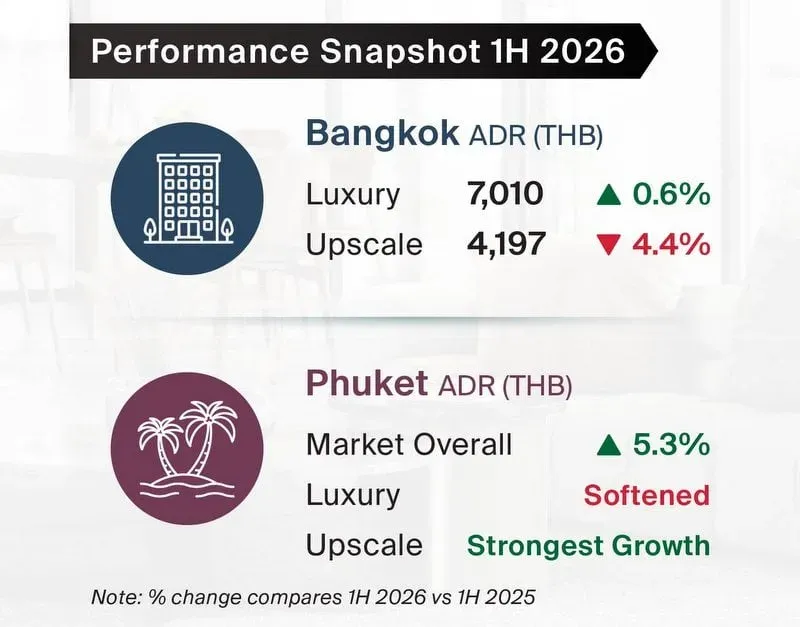
Phuket had 47,195 hotel rooms at the end of the first half of 2026, with about 58% classified as luxury or upscale, according to Knight Frank Thailand’s latest Hotel Market Research report.
The premium concentration is set to grow. About 89% of the rooms scheduled to open between 2026 and 2028 are in the luxury or upscale categories, including approximately 1,460 rooms planned for delivery in 2027 and 1,193 in 2028.
Knight Frank said the expanding supply of premium properties would raise expectations for hotel quality, service and guest experience across Phuket, putting pressure on existing operators to remain competitive. It cautioned, however, that premium positioning alone would not guarantee stronger performance.
Phuket’s overall average daily rate (ADR) rose 5.3% year on year to B7,117 in the first half of 2026, despite a 3.2-percentage-point fall in occupancy. Among segments, upscale hotels recorded the strongest rate growth, followed by midscale properties, while luxury ADR declined.
“Developing a luxury hotel does not guarantee success. What it does mean is that the competitive benchmark is rising,” said Carlos Martinez, director of Research & Consultancy at Knight Frank Thailand. “As guests are presented with more choice, hotels need to give them a compelling reason to choose their property – and to pay the rate being asked.”
New developments are also spreading beyond Phuket’s traditional concentration in Patong. Projects are being developed in Bang Tao, Kata and southern and south-eastern areas including Chalong, Rawai and Nai Harn. Knight Frank said this could increase direct competition between hotels with similar positioning, prices and target markets in the same resort areas.
Existing owners may not need to undertake complete redevelopment to protect their market position, the report said. Refurbishment, repositioning, stronger food and beverage and event concepts, wellness and family-oriented offerings, and improved distribution could help established properties compete.
Branded residences could support the economics of selected high-end resort projects, although Knight Frank said the model requires careful phasing, consistent brand standards and long-term resort management.
“Future competition will not be about who has the newest hotel, but about who creates the most differentiated value for guests,” Mr Martinez said. “Competition is now shaped as much by the quality of supply entering the market as by visitor numbers.”
Knight Frank said delivery schedules remained subject to change. Construction costs were expected to rise by about 3-5% in 2026, while infrastructure constraints, approvals and project phasing could delay some developments and increase the appeal of hotel conversions and refurbishment.
The firm said existing operators should not rely on delays to reduce future competition, as the market’s overall direction pointed towards higher standards for hotel products in Phuket.