UPDATE: Thai government rejects Phuket 'blue regime' claim after People’s Party MPs allege entrenched influence
Thailand’s government has rejected a People’s Party claim of a “blue regime” in Phuket, while saying police have uncovered suspected nominee companies and land holdings as authorities pursue longstanding influence networks in the province.

A deputy government spokeswoman on June 23 rejected a People’s Party claim that a so-called “blue regime” was taking root in Phuket, while saying the government was making progress against longstanding networks of influence in the province and inviting anyone with evidence of extortion or mafia activity to submit it for legal action.
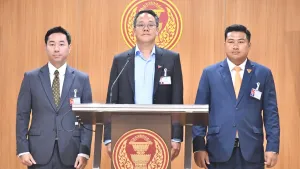
The response came after People’s Party MPs Chalermpong Saengdee and Pakamon Nunanant on June 22 raised concerns about what they described as an entrenched political influence network in Phuket, alleging that extortion and unofficial payments are harming the province’s economy, damaging honest businesses and undermining investor confidence.
Chalermpong, a Phuket MP for Constituency 2, said the issue in Phuket goes beyond the transfer of the provincial governor, deputy governor and the commander of Provincial Police Region 8. He said the problem is structural and involves influential figures with deep roots in the province.
He said a police officer had warned him to be careful, which he described as a sign that powerful interests were operating without fear of the law. According to Chalermpong, those interests are linked to politics, authority and local benefits, and have led to pressure on business operators through long-running demands for payments.
Pakamon, a party-list MP from the People’s Party, said the transfer of Phuket officials appeared to be only one scene in a larger political drama. She said business operators in Phuket had sent her a letter saying the reshuffle had affected investment confidence because investors no longer knew whom they would need to approach and whether they could operate safely.
She said complainants had told her that investing in Phuket requires not only business capital but also preparation for the cost of unofficial payments. She argued that straightforward investment could not take place under such conditions and said the resulting damage was falling on Phuket’s economy, which she described as important to Thailand as a whole.
Deputy government spokeswoman Ploythalee Laksamee Saengchan said it could not be denied that problems in Phuket, especially involving influential figures, are deep-rooted and have built up over a long time. She said the government under Prime Minister and Interior Minister Anutin Charnvirakul wanted concrete results through coordinated action by relevant agencies.
She said the Royal Thai Police had recently sent officers to Phuket and found 10 companies showing nominee-like behavior. In that group, authorities found four land plots totaling 2 rai, 1 ngan and 50.5 square wah with an estimated value of about 116 million baht, and a court approved 13 arrest warrants for 12 foreigners, she said.
She said authorities also identified 39 companies that bought or held land while foreign shareholders held more than half the shares. In that second group, authorities found 52 land plots totaling about 12 rai, 2 ngan and 62.5 square wah with an estimated value of about 115 million baht, and a court approved 29 search warrants, she said.
Combined, the two groups involved 56 land plots covering 15 rai and 13 square wah with an estimated value of about 231 million baht, according to Ploythalee.
She said the prime minister and a deputy interior minister had both visited the area to keep driving the response, and said any influential figures found to have broken the law would face strict legal action with no exceptions.
On the transfer of Phuket’s governor, Ploythalee said it was intended to improve problem-solving for local residents, not to place officials to serve a political party. She also rejected the allegation of a “blue regime” in Phuket.
Chalermpong had said the government should focus on investigating networks of influence in Phuket, gathering evidence and prosecuting those involved. He also said the issue was not only about under-the-table money, but about broader damage to Phuket’s economy, honest entrepreneurs, investment opportunities, the province’s credibility and tourists’ sense of safety.
Pakamon had also questioned whether the transfers of Phuket’s governor and deputy governor were related to local influence groups or political bargaining. She called on the government and the prime minister to explain the facts behind the reshuffle and to show that it was not an attempt to entrench political power in the province.
Both MPs said symbolic action would not be enough and urged a clearer response from the government over allegations of entrenched influence and their impact on Phuket. Ploythalee said anyone with information about extortion payments or mafia activity should submit it to the government, which was ready to pursue the matter to the fullest extent of the law.