UPDATE: Phuket expressway plan totals B84.218 billion as Kathu–Patong phase heads for Cabinet approval in December 2026
EXAT plans to seek Cabinet approval in December 2026 for the B16.757 billion Kathu–Patong phase; Prachachat reports the wider 34.60-kilometre plan at B84.218 billion, with Phase 1 construction targeted for October 2027.
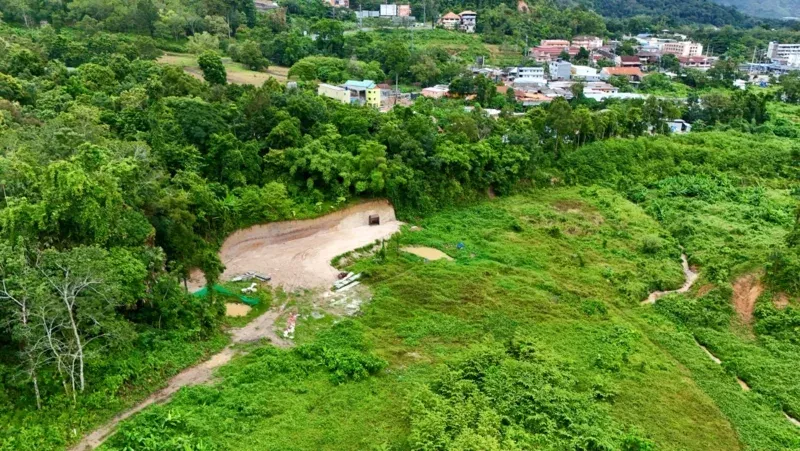
The Expressway Authority of Thailand (EXAT) plans to seek Cabinet approval in December 2026 for revised details of the first phase of Phuket’s planned expressway, a 3.98-kilometre route linking Kathu and Patong Beach.
The phase is estimated to cost B16.757 billion, including B5.792 billion for land acquisition and B10.965 billion for construction and supervision. EXAT Governor Surachet Laophulsuk said land acquisition was 99.43% complete and is expected to be finished in January 2027. The Phuket News reported that the project was under consideration by the Ministry of Transport ahead of the planned Cabinet submission.
Prachachat reported the full planned expressway as a 34.60-kilometre route costing B84.218 billion and linking Kathu, Thalang and Phuket City. That is a broader-project total covering the two phases and does not replace EXAT’s stated Phase 1 land-acquisition allocation.
Prachachat also reported about B30 billion in expropriation costs for the broader expressway plan, covering 1,604 rai and 343 homes. Its description of Phase 1 expropriation as completed differs from EXAT’s precise 99.43% figure. The reports do not establish whether completed is a rounded description or reflects a later stage of the process.
The revised plan reduces the width of the tunnel beneath Nak Koet Mountain from 17.1 metres to 14.2 metres while retaining its 1.85-kilometre length. EXAT said the change reflects construction-material and fuel costs, geological study findings and requirements related to earthquake resistance.
Prachachat described the 1.85-kilometre mountain crossing as twin tunnels and called it the largest in Asia. The tunnel system is designed for cars and motorcycles, with four traffic lanes separated by safety barriers.
Prachachat also quoted EXAT as saying the complete route could reduce travel time from about 1.5 hours to 20 minutes. For the Kathu–Patong section, EXAT estimates a reduction from about 30 minutes to five minutes.
Proposed tolls are B10 for motorcycles, B20 for four-wheel vehicles, B40 for vehicles with six to 10 wheels and B60 for vehicles with more than 10 wheels. EXAT estimates daily revenue of about B960,000 and an economic internal rate of return of 19.47% for the first phase.
Second phase and funding
Under EXAT’s plan, the second phase would link Mai Khao, Ko Kaeo and Kathu, cover 30.62 kilometres and cost about B67.461 billion. Prachachat’s account breaks that figure into about B29.548 billion for land acquisition and B37.914 billion for construction and supervision.
EXAT is preparing the detailed design, with completion expected around January–February 2027. Its timetable targets Cabinet consideration in October 2027. Under the planned alignment, the route would include at-grade and elevated sections, as well as a tunnel through the Kamala mountain range, before connecting with the first phase near Highway 4029.
A proposed spur at Ma-Nik 2 would direct traffic towards Phuket town. EXAT also plans a 37-rai service area and a 13-rai rest stop, both of which would be opened to private investment.
EXAT’s account identifies Mai Khao as the Phase 2 endpoint, while Prachachat and The Phuket News identify it as Mueang Mai. The available reports do not establish whether this reflects a place-name variation or a route change. The Phuket News reported a Cabinet submission in September 2027 followed by a construction start in October 2028; EXAT’s timetable instead targets Cabinet consideration in October 2027 and construction in 2029.
The Phuket News also reported a different Phase 2 estimate of B46.75 billion, comprising B22.01 billion for land acquisition and B24.74 billion for construction and supervision. The available reports do not establish which cost figure is correct, so the discrepancy remains unresolved.
EXAT said rising global construction costs could mean that financial returns from the second phase would not cover borrowing costs. The authority is reviewing ways to reduce construction costs while maintaining safety standards.
EXAT is also discussing an infrastructure fund with the State Enterprise Policy Office. The Phuket News reported that EXAT is preparing to raise about B20 billion through an infrastructure fund for the Kathu–Patong phase, within a broader SEPO programme of about B60–70 billion. It said further details on the wider fundraising programme are expected from 2027.
Under the preliminary plan, about B1 billion a year from EXAT’s income could support the fund, including revenue from the Bang Phli–Suksawat expressway, which currently generates about B2.6 billion annually in tolls. Systems, toll collection and operations and maintenance would be offered to private investors under a public-private partnership model.
EXAT plans to complete the first phase’s terms of reference in April 2027 and begin construction in October 2027, with construction expected to take 48 months. Land acquisition for the second phase is planned for 2027–2030, with construction beginning in 2029 under EXAT’s timetable. The authority aims to open both phases fully in October 2031, when combined traffic is forecast at about 50,000–60,000 vehicles a day.