
Phuket property group urges urgent state infrastructure spending as demand outpaces capacity
Phuket’s real estate sector says surging private investment is straining the island’s roads, water, electricity and waste systems, and is calling on the central government to fund urgent infrastructure upgrades.
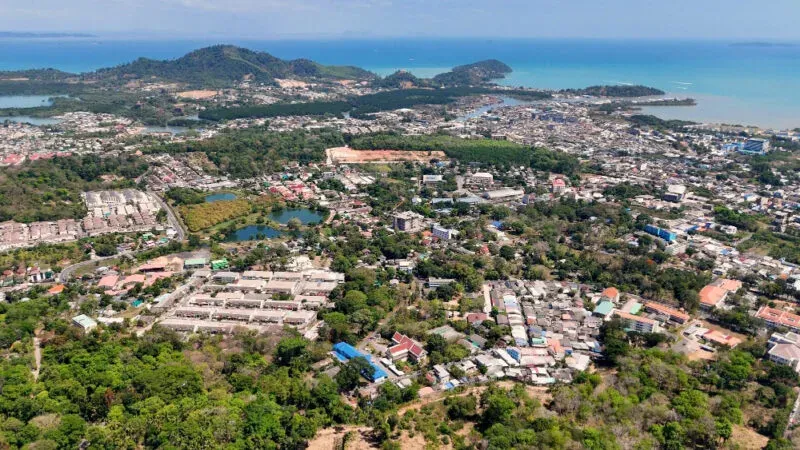
Phuket’s private sector is urging Thailand’s central government to accelerate spending on basic infrastructure, saying rapid growth in property and related investment is overwhelming the island’s capacity in roads, water, electricity and waste management.
In an interview with Prachachat Turakij, Phuket Real Estate Association president Methapong Upatisring said demand in Phuket remains strong, with private investment continuing to flow into housing, international schools, restaurants and other businesses. He said the island’s growth has moved beyond what its basic utilities can support.
According to Methapong, Phuket does not need a large-scale mass transit or rail system immediately, but does need urgent upgrades to fundamental infrastructure. He cited insufficient road capacity, the need for more intersections and underpasses at traffic bottlenecks, road maintenance, proper water supply and drainage systems, and more effective waste management.
He said the waste problem has become particularly severe, with garbage volumes exceeding the capacity of the single incinerator at Saphan Hin. That has led to an accumulation of more than 1 million tons of waste in the urban area while waiting for state-backed investment. He also said a planned water pipeline from Ratchaprapha Dam in Surat Thani has yet to make concrete progress, while electricity supply is beginning to lag behind expansion in the property sector.
Methapong said the most critical structural weakness is transport and the road network. He added that local administrators and officials have capability, but are constrained by limited authority and budgets if funding is not allocated from the central government.
On the property market, he said Phuket’s real estate sector has grown to rank among the country’s five or six largest markets. Condominiums account for more than half of the overall market, with low-rise housing and luxury homes making up the rest. He said new condo supply has risen quickly in the two to three years since the pandemic, especially in Cherng Talay, which has become a major investment location for both listed and unlisted developers.
Methapong rejected concerns that Phuket is in a property bubble, saying research and market statistics show absorption rates remain healthy and overall conditions are still normal. He said some areas may take as long as 24 months to clear stock, meaning new developers need to study locations carefully and avoid weaker sites. Even so, he said Phuket’s inventory situation remains less worrying than in some Bangkok condominium locations, where sales periods can stretch to six years.
He also said tourism-related property, including hotels and serviced apartments, continues to perform well. In prime locations, occupancy rates remain around 80% to 90%, despite growth in room supply.
Foreign demand for Phuket property also remains strong, he said. Buyers from Russia, China and France remain the top three foreign demand groups in the market, excluding hotels. He said buyers residing in Dubai and other Middle Eastern countries have recently started making purchases in Phuket for second homes and vacation homes, though the trend is still new and not yet fully reflected in official statistics.
According to Methapong, these buyers typically use 30-year leasehold structures for landed property, in line with Thai law, or buy condominium units under the foreign ownership quota. He said there are also early signs that large Dubai-based developers are studying possible large-scale investment in Phuket.
The growth in property has also supported related sectors, especially international schools. Methapong said Phuket now has more than 20 international schools across the island, serving children of foreign residents who have relocated for the long term.
He said, however, that Phuket’s economy still depends overwhelmingly on tourism. Other sectors, including property, schools, hospitals, restaurants and retail space, rise or slow in line with the tourism industry.
Methapong also said rising property prices are being driven by real costs rather than speculation. He pointed to higher land prices caused by competition from new residents and foreign investors, along with higher construction material and labor costs in Phuket.
On concerns over investigations and transfers involving senior officials in Phuket, Methapong said the private sector wants transparency and continuity. He said frequent changes in senior officials can temporarily delay approvals and licenses needed by the property sector, although he does not see such personnel changes as the main factor affecting large development projects.
He said broader structural factors such as market conditions, investment feasibility, tourist numbers and tax measures are more significant in determining whether major projects move ahead.
Methapong added that Phuket’s business sector is ready to support any political party that can help develop the province and sustain its economy, stressing that the priority is practical results for Phuket rather than partisan alignment.