UPDATE: Thai Election Commission votes to refer 26 serving senators to Supreme Court over alleged Senate election offences
Thailand’s Election Commission voted on 14 September to refer 26 serving senators to the Supreme Court over alleged breaches of candidate-introduction rules linked to the June 2024 Senate selection; the referral is not a finding of guilt or disqualification.
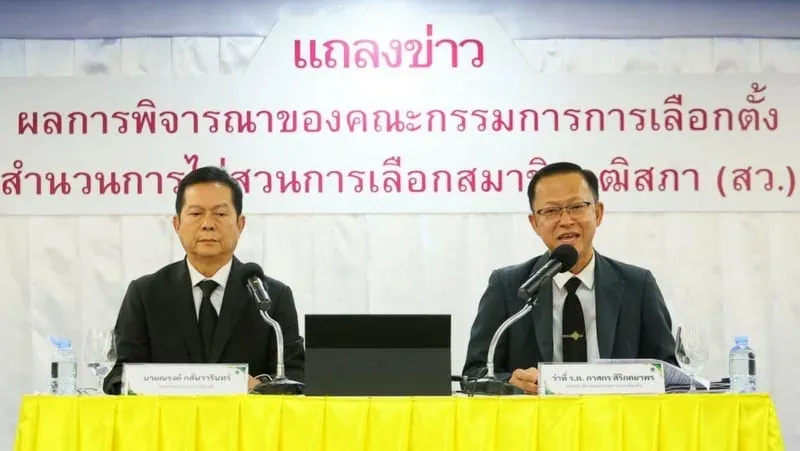
Thailand’s Election Commission (EC) voted on 14 September 2026 to refer 26 serving senators to the Supreme Court’s Election Cases Division over alleged breaches of candidate-introduction rules linked to the June 2024 Senate selection.
The Nation reported on 15 September that the EC’s official referral covered 77 people: 26 senators, 36 people eligible to vote in the Senate selection process and 15 others, from among 427 people accused in the case. The referral was for the Supreme Court to consider electoral disqualification; it was not a final verdict of guilt and did not itself impose disqualification.
EC chairman Narong Klunwarin defended the decision at the press conference announcing it. He said the commission had acted within the law and that its members were prepared to explain their actions in court if challenged. Narong said the EC had held a press conference to explain the facts openly rather than issue only a written statement, and that it had nothing to conceal.
The supplied reports do not fully reconcile the case’s aggregate figures. The Nation’s 14 September account said the EC had decided that 113 people should be referred to the Supreme Court under allegations three to seven, while its 15 September account gave 77 as the official referral breakdown. The figures may describe different stages or categories of the case, but the reports do not explain the difference and they should not be treated as interchangeable.
The Nation reported that the 26 senators were included under allegation three, concerning procedures and conditions for candidates introducing themselves during the Senate selection process. The EC considered seven allegations involving 427 people and found no grounds to proceed under allegations one and two. Those allegations concerned political figures helping candidates secure Senate seats and candidates agreeing to accept such assistance. No political party office-holders, party executives or MPs are being referred under those two allegations.
The allegations pursued under three to seven cover alleged failures to follow candidate-introduction rules and alleged inducements involving benefits or hospitality offered to influence candidates or voters. They also include alleged benefits sought in return for standing as a candidate or selecting, or not selecting, a particular person. The EC’s decision to pursue allegations three to seven does not mean every person referred faces all five allegations.
In a separate account, The Phuket News described the case as involving 77 accused people, including the 26 senators, 36 unsuccessful Senate candidates and 15 other political figures. None of those accused was identified. The newer Nation account described the 36 in the official referral breakdown as people eligible to vote in the Senate selection process, so the supplied reports do not establish that all 36 were unsuccessful candidates. The Phuket News reported that the allegations involved senators allied with Prime Minister Anutin Charnvirakul’s Bhumjaithai party.
The EC has 60 days to file its petition. The Supreme Court will then decide whether to hear the case. The Phuket News reported that those convicted could face up to 10 years in prison for each offence, a fine of B200,000, or both.
The EC Office began investigating the case in 2024 through Central Investigation and Inquiry Committee No. 26, which included representatives of the EC Office and the Department of Special Investigation. After an inquiry lasting about two years, the committee recommended proceedings against 229 people.
Earlier reports also cited 229 people, although senior EC officials did not confirm that figure at a news conference. The Nation’s account described the group as comprising 138 serving senators; 21 ministers, MPs and Bhumjaithai Party executives; 20 people described as part of the Bhumjaithai network; and 50 people on the Senate reserve list or among other Senate candidates.
The Nation reported that Adjudication Subcommittee No. 36, appointed during Ittiporn Boonpracong’s tenure as EC chairman, later voted five to two to recommend dismissing all complaints against the 229 people. The full commission considered both sets of recommendations, meeting every Monday from early June and concluding its review on 31 August before voting on 14 September.
The 200-member Senate was selected through a three-round process in June 2024. Candidates chose other candidates to represent 20 sectors, including justice, education, public health, industry, arts and sport, rather than being elected directly by Thai voters. Analysts said the final Senate included significant numbers of former civil servants, military and police officers, as well as many supporters of Bhumjaithai.
The Senate scrutinises bills passed by the lower house and appoints the heads of key bodies including the Constitutional Court, the National Anti-Corruption Commission and the Election Commission.
The Phuket News reported that hundreds of people marched through Bangkok on Sunday, calling for the indictment of the 229 people in a protest organised by accountability watchdog iLaw. Yingcheep Atchanont, iLaw’s executive director, said the organisation would release documents it says came from the EC’s investigation if the Supreme Court declines to hear the case.